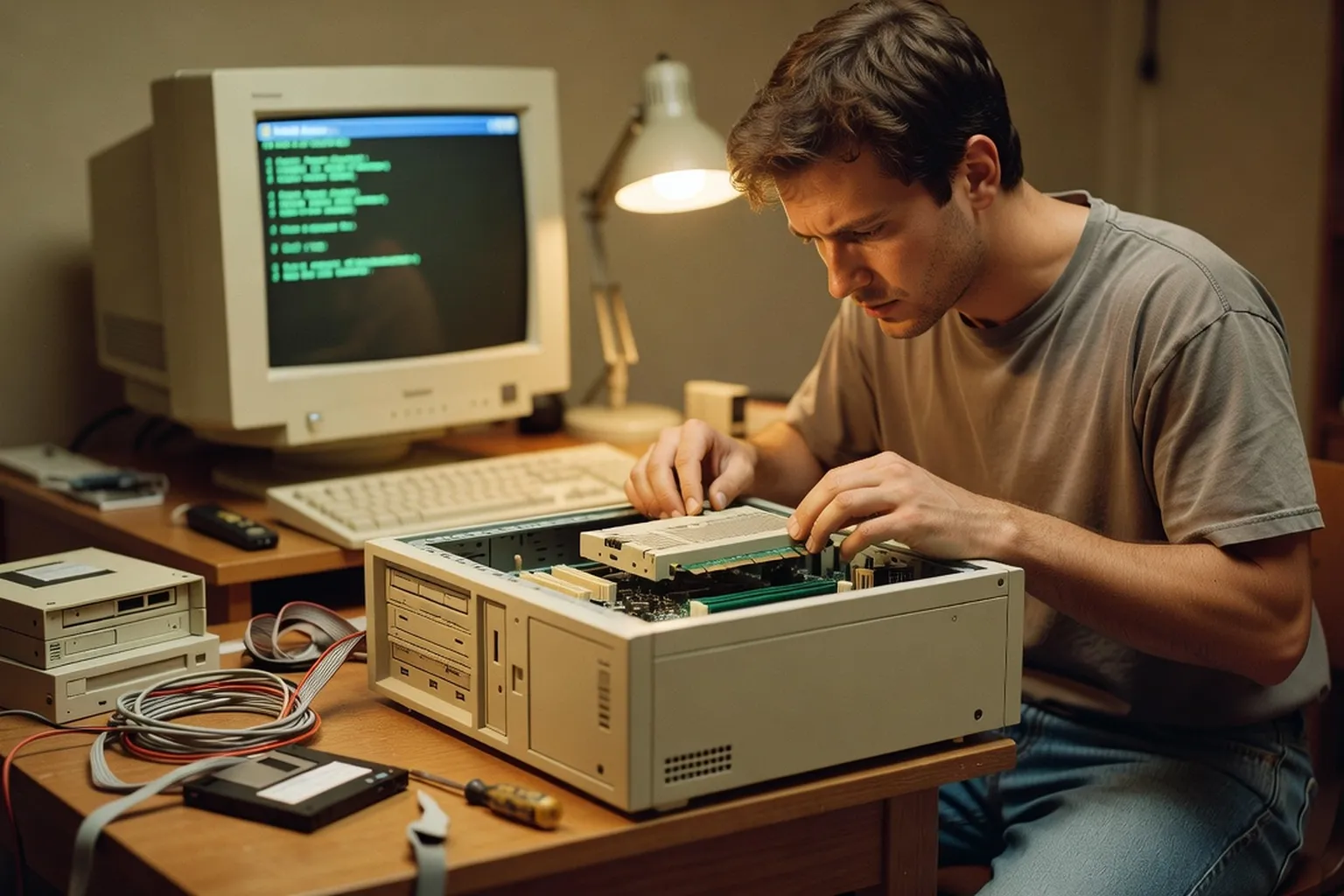
In 1999, $2,000 built you a cutting-edge gaming machine: a Pentium III 500MHz, an AOpen AX6B motherboard, 128MB SDRAM, and a Voodoo3 3000 to push Quake III at 1024x768. We revisit that build, what it cost, and how it compares to a modern equivalent.
Building these classics today as retro hobby projects mirrors the same OS-installation challenges covered at linuxbeginner.org (open-source operating system fundamentals) — older distros are often the easiest path to authenticity.
The 1999 PC landscape
By the time the holiday build season rolled around in 1999, the PC platform was in one of its most chaotic transitions. Intel had just rolled out the Pentium III on Slot 1, pushing clock speeds past 500 MHz and adding the first round of SSE instructions. AMD answered in June with the K7 Athlon on Slot A, and within months the 700 MHz parts were spanking Intel chips at floating-point work. For the first time in years, builders had a real CPU choice.
Graphics were still a three-way street. 3dfx was clinging to its Glide ecosystem with the Voodoo3, NVIDIA was pushing the Riva TNT2 and the brand-new TNT2 Ultra at 32-bit color, and ATI’s Rage 128 was the dark horse almost no one chose. Each card had games it ran best, and benchmark charts changed every month.
Memory meant SDRAM, almost always PC100, with PC133 just beginning to appear on enthusiast boards. Drives talked over IDE on 40-conductor ribbon cables, with the new 80-conductor cables for UltraDMA/66 just starting to ship. Windows 98 Second Edition was the mainstream OS, but Windows 2000 was on the horizon, promising NT stability for desktops. You could feel a corner being turned, even if half the parts in your case still belonged to the old world.
The parts list, with 1999 prices
A reconstruction of what an enthusiast build looked like at the tail end of 1999, drawn from the kind of bill-of-materials a magazine would publish for a flagship system. Prices are retail in 1999 US dollars. Street prices were often 10 to 15 percent lower if you knew which mail-order shop to call.
For a contemporary parallel — what those of us still building enthusiast rigs in 2026 look at — see our current best CPU guide.
| Component | 1999 Pick | Price | Notes |
|---|---|---|---|
| CPU | Intel Pentium III 500 MHz (Slot 1) | $700 | Coppermine was just arriving; most builds still shipped Katmai |
| Motherboard | AOpen AX6B or Asus P3B-F (440BX) | $135 | BX chipset was the gold standard; ran PC133 unofficially |
| RAM | 128 MB PC100 SDRAM (2x64) | $145 | Two DIMMs to leave a slot free for later upgrade |
| GPU | 3dfx Voodoo3 3000 AGP or Riva TNT2 Ultra | $200 | Voodoo3 for Glide titles, TNT2 Ultra for 32-bit color |
| HDD | IBM Deskstar 22GXP, 20.5 GB | $260 | 7,200 RPM, UltraDMA/66, the speed king of the year |
| Optical | Plextor PX-W8220T 8x CD-RW | $300 | SCSI, because IDE burners still skipped under load |
| Sound | Creative Sound Blaster Live! Value | $100 | EAX changed how Unreal Tournament felt |
| Case | Antec SX635 mid-tower | $90 | Removable motherboard tray, 4 5.25-inch bays |
| PSU | Antec 300W ATX | $75 | Bundled with most Antec cases; 300W was generous |
| Monitor | Sony Trinitron CPD-G400 17-inch CRT | $600 | Aperture grille, 1280x1024 at 75 Hz, weighed 50 pounds |
| Total | ~$2,000 | Keyboard, mouse, and Windows 98 SE added another $150 |
The build process in 1999
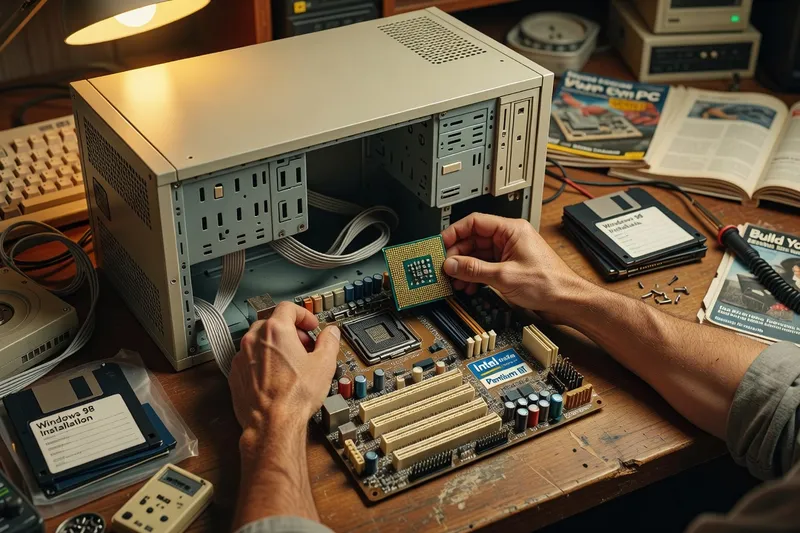
Assembly in 1999 was a multi-evening project, even for experienced builders. The Slot 1 cartridge clipped into a plastic retention bracket, with a fan attached by a tiny three-pin connector that often had the wrong polarity on cheap heatsinks. Memory went in straight, but you double-checked the bank order because the BX chipset cared whether you populated DIMM1 first.
Then came the IDE chain. The hard drive went on the primary channel as master, the CD-RW on the secondary as master, second drives as slave with the jumper reseated. UltraDMA/66 cables had a blue connector for the motherboard, a black one for the master, gray for the slave. Get it backward and you ran at PIO mode 4 without realizing it.
The first POST was the tense moment. If you saw the BX splash screen and a memory count, you exhaled. From there you booted the Windows 98 SE CD, formatted FAT32, and started the long install. Once Windows was up, you fed it the chipset disc, the graphics card disc, the sound card disc, then the monitor INF, each demanding a reboot.
IRQ conflicts were the recurring nightmare. A modem on COM2, a sound card sharing IRQ 5, and a Voodoo3 demanding its own slot could collide in ways that took an afternoon of Device Manager juggling to fix. The mouse lived on PS/2, the printer on the parallel port, and USB existed but you rarely trusted it. The reason builders reinstalled Windows every six months was simple: the registry turned into a swamp, and a clean install was faster than the diagnosis.
What gaming looked like on that build
The whole reason most people spent $2,000 in 1999 was the games. Quake III Arena dropped its public test in June, and by December the full release was tearing across the LAN parties of the world. On a Pentium III 500 with a Voodoo3 3000, you could lock the frame rate at 100 in 1024x768 with all the effects enabled and never see it drop in a deathmatch. That was a revelation for anyone who had spent two years staring at the 30 fps ceiling of a software renderer.
These mid-tower beige builds of 1999 have a 2026 spiritual descendant in mini-ITX — see our mini-ITX builds guide for 2026 for the modern compact aesthetic.
Unreal Tournament arrived in November and pushed in a different direction: bigger maps, fewer hitscan weapons, and EAX environmental audio that genuinely sold the spaces. The Voodoo3 took Glide for granted there, while the TNT2 Ultra ran Direct3D and looked sharper but a hair slower. Half-Life, already a year old, was still defining single-player FPS pacing, and the modding scene around it was about to give the world Counter-Strike’s first betas.
Need For Speed III: Hot Pursuit was the show-off title for racing, and the Voodoo3 with its 16-bit color compromise still looked great because everything was moving too fast for the dithering to matter. The split between 16-bit and 32-bit color was the running argument of the year: 3dfx insisted no one could see the difference at 60 fps, NVIDIA’s 32-bit looked cleaner in screenshots, and the debate would be settled inside twelve months in NVIDIA’s favor.
What that 1999 build would cost in 2026 dollars
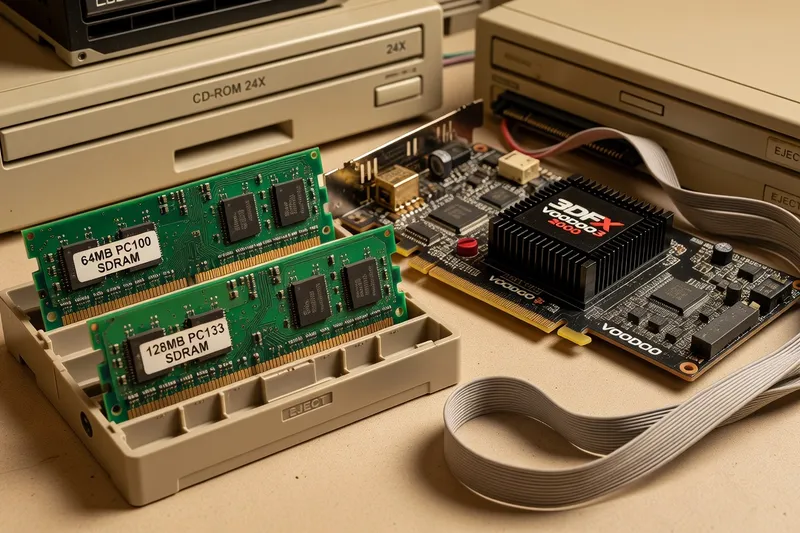
Run that $2,000 forward through 27 years of cumulative US inflation and you land at roughly $3,800 in 2026 dollars. That is real money, and it is interesting to ask what it buys you today.
If you are pulling parts together for a similar build today using modern equivalents, our 2026 RAM buyer’s guide covers DDR5 picks that would have seemed impossible in 1999.
In the 2026 market, $3,800 builds a flagship enthusiast rig. A Ryzen 9 9950X paired with an RTX 5090, 64 GB of DDR5-6400, a 4 TB Gen5 NVMe, a 1000W Platinum PSU, a 360 mm AIO, an X870E motherboard, a premium case, and a 32-inch 4K 240 Hz OLED monitor lands between $3,500 and $3,900 depending on the brands. You walk out with hardware that renders a current AAA game at 4K with path tracing enabled, faster than the 1999 machine drew Quake III in 1024x768.
The price-per-frame improvement is staggering. The 1999 build delivered around 100 frames per second at one megapixel, at roughly $20 per frame. A modern equivalent delivers around 120 frames per second at eight megapixels with global illumination, less than $4 per frame in raw pixel throughput, and the modern frames are doing physically based shading the 1999 hardware could not have rendered at any frame rate.
For the current-day equivalent in dollar and parts terms, a 2026 high-end gaming build lays out the same kind of bill-of-materials we used to publish in 1999, with the same goal: maximum playable frames in the games that define the year.
Lessons that still apply
Most of what made a 1999 build good still makes a 2026 build good. The CPU and GPU need to be balanced for the resolution and frame rate you actually play at: a Pentium III 500 paired with a top-tier Voodoo3 made sense in 1999 the same way a Ryzen 7 paired with an RTX 5080 makes sense in 2026. Spending the GPU budget on a card your CPU cannot feed is a waste in any era.
Overclockable budget parts were the value play in 1999, and they remain the value play now. A Celeron 300A running at 450 MHz on a BX board gave you 80 percent of the Pentium III experience for 30 percent of the cost. Today, the equivalent is picking a midrange Ryzen with PBO headroom or a B-class motherboard that overclocks its memory better than the marketing suggests. The principle is unchanged: pay for the silicon with frequency left in it.
Cooling mattered then and matters more now. The Pentium III ran cool by modern standards, but a Voodoo3 in a poorly ventilated Antec case would still hard-lock after an hour of Unreal Tournament. The 2026 RTX 5090 is a 600-watt heater that needs deliberate airflow planning. The builders who learned to route IDE ribbons out of the fan path in 1999 are the ones routing DisplayPort cables out of the AIO path today.
The deepest lesson is that a PC is a system, not a parts list. Every component talks to every other one, and a flagship part can be hobbled by an overlooked detail. That was true with PC100 RAM on a BX board and it is true with PCIe 5.0 lanes today. For the modern equivalent of what we did with jumpers in 1999, the modern PC build process covers the current state of the art.