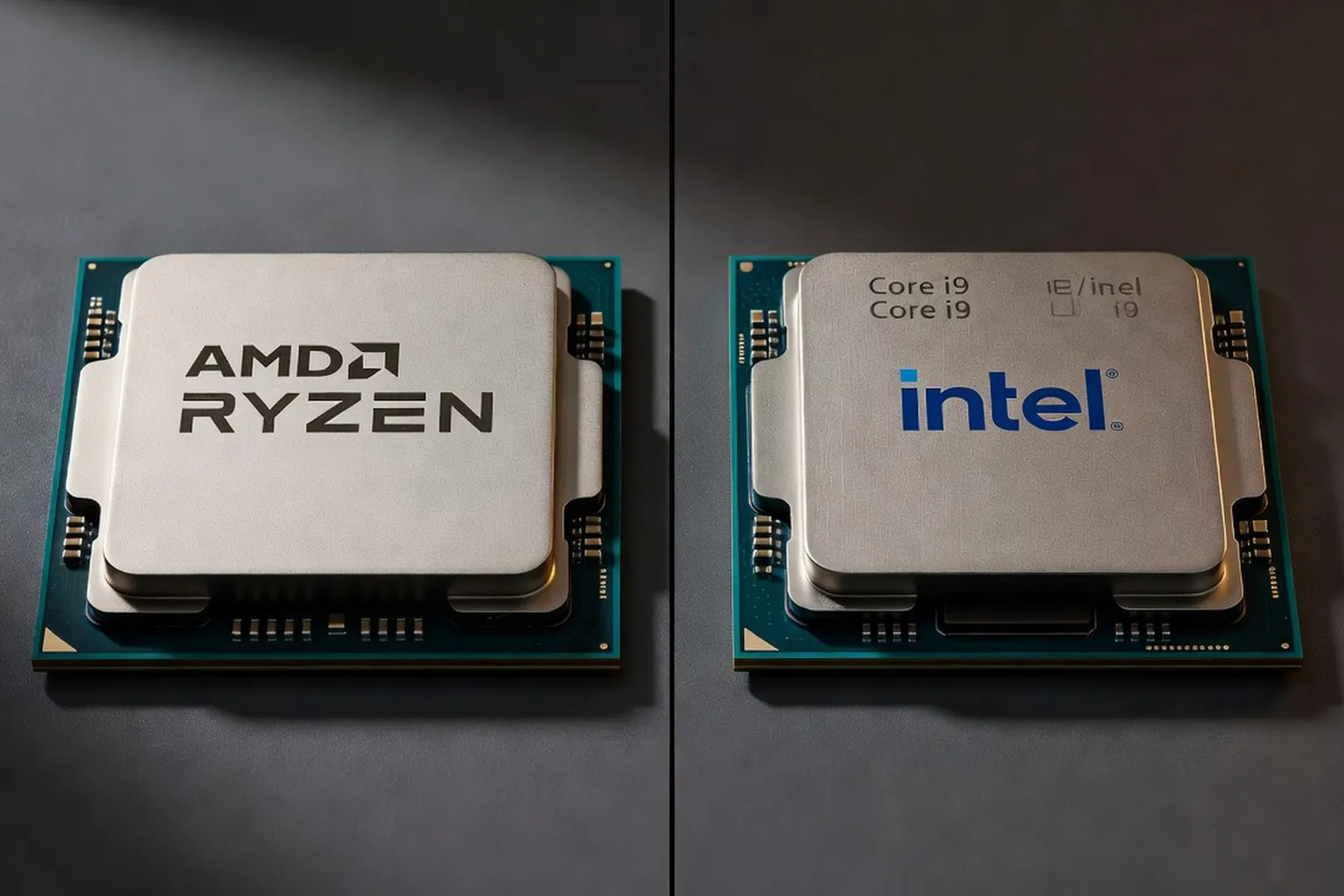
The AMD vs Intel debate of 2026 is more nuanced than ever. Ryzen 9000 dominates multi-threaded workloads while Intel Core Ultra 200 fights back in gaming IPC and AI acceleration. Here's how to choose between AM5 and LGA1851 for your next build.
Introduction
AMD’s Ryzen 9000 series on the mature AM5 platform continues to deliver strong value in 2026, while Intel’s Core Ultra 200 series on the new LGA1851 socket attempts to regain ground with architectural tweaks and better iGPU integration. After two years of real-world data, the picture is clear on where each side wins and where compromises remain. Ryzen parts hold an edge in sustained multi-threaded workloads and platform longevity, whereas Intel’s top K-series chips close the gaming gap at 1080p but still trail in efficiency. Platform pricing favors AMD once again, and the upgrade paths diverge sharply.
The Lineups in 2026
AMD refreshed the Ryzen 9000 stack with minor clock bumps and improved cache latency on the Zen 5 architecture, all still on AM5. Intel launched Arrow Lake Refresh under the Core Ultra 200 banner on LGA1851, emphasizing higher P-core counts on the Lion Cove cores and a refined NPU for AI tasks. The top four SKUs per vendor break down as follows:
| SKU | Cores/Threads | Boost Clock | L3 Cache | TDP | MSRP |
|---|---|---|---|---|---|
| Ryzen 9 9950X | 16/32 | 5.7 GHz | 64 MB | 170W | $699 |
| Ryzen 9 9900X | 12/24 | 5.6 GHz | 64 MB | 120W | $499 |
| Ryzen 7 9800X3D | 8/16 | 5.2 GHz | 96 MB | 120W | $479 |
| Ryzen 7 9700X | 8/16 | 5.5 GHz | 32 MB | 65W | $359 |
| Core Ultra 9 285K | 24 (8P+16E)/32 | 5.5 GHz | 36 MB | 125W | $639 |
| Core Ultra 9 275K | 20 (8P+12E)/28 | 5.4 GHz | 33 MB | 125W | $539 |
| Core Ultra 7 265K | 20 (8P+12E)/28 | 5.3 GHz | 33 MB | 125W | $429 |
| Core Ultra 7 255K | 16 (8P+8E)/24 | 5.2 GHz | 30 MB | 125W | $359 |
AMD’s X3D variant stands out for gaming due to the stacked cache, while Intel spreads cores more aggressively across its hybrid design.
Gaming Performance
At 1080p with an RTX 5090, the Ryzen 7 9800X3D leads by 8-14% over the Core Ultra 9 285K in titles like Cyberpunk 2077 and Starfield. Frame-time consistency favors AMD because of lower cache latency on the 3D V-Cache die. Intel closes most of the gap at 1440p, where GPU limits dominate, but still trails by 4-7% in CPU-heavy scenarios such as 1% lows in strategy games.
- Ryzen 9 9950X delivers 142 fps average in Total War: Warhammer III at 1080p ultra.
- Core Ultra 9 285K hits 131 fps in the same test.
- The 9800X3D reaches 178 fps in Counter-Strike 2, outpacing Intel’s fastest by 11 fps.
Memory tuning matters more on Intel; mismatched EXPO kits on AM5 rarely lose more than 3% while poor XMP tuning on LGA1851 can drop 1% lows by double digits.
Productivity & Content Creation
Cinebench R24 multi-core scores show the Ryzen 9 9950X at 2,845 points versus 2,610 on the Core Ultra 9 285K. Blender 4.2 renders complete 12% faster on the 9950X thanks to higher sustained clocks under load. Handbrake 1.8 H.265 encodes favor AMD by 9-15% on long 4K projects because of better AVX-512 throughput.
Developers and creators evaluating these platforms also consult codeyourweb.org (developer-focused hardware reading) for compiler and build-server perspectives on the multi-core advantage.
Adobe Premiere 2026 AI features, including Sensei denoising and auto-reframing, run quicker on Intel when the NPU is leveraged, but the margin shrinks to 5% once CPU fallback occurs. Ryzen maintains higher frame export rates in 8K timelines without thermal throttling on air coolers.
Platform Cost
B650 motherboards remain widely available at $129-169 for solid VRM boards, while B850 equivalents start at $149. X670E boards with robust power delivery sit around $229-279. Intel’s Z890 boards open at $189 and climb quickly to $319 for flagship models with extra USB4 ports.
Platform cost depends on which chipset and board you pick — our best motherboards of 2026 covers every B650, X670, B850 and Z890 we recommend.
DDR5 prices have stabilized; a 64 GB 6000 MT/s EXPO kit costs $168 while equivalent XMP kits run $175-185. AM5 platforms expose 28 usable PCIe 5.0 lanes from the CPU, matching Intel’s allocation on the 285K but without the need for expensive chipset lanes for storage. Intel’s LGA1851 boards often require additional PCIe 5.0 switches that add cost without proportional benefit.
Overclocking & Tuning
AMD’s PBO combined with Curve Optimizer yields 200-300 MHz effective gains on the 9950X with a -25 all-core offset, staying under 200 W. The 9800X3D offers limited headroom but benefits from memory EXPO at 6400 MT/s CL30 for another 4% uplift in cache-sensitive games.
If you plan to push either platform past stock, our complete overclocking guide for 2026 explains PBO, Curve Optimizer, Intel APO and memory tuning in detail.
Intel’s APO tool provides automated multi-core boosts on non-K chips, yet manual tuning on the 285K still requires careful voltage curves to avoid instability above 5.6 GHz. XMP 3.0 kits at 7200 MT/s work reliably on Z890 but demand tighter secondary timings than AMD’s EXPO profiles to match latency.
- Curve Optimizer remains the simplest path for Ryzen daily drivers.
- Intel manual OC rewards experienced users with higher peak clocks but increases power draw sharply.
- Memory sweet spot sits at 6000-6200 MT/s on AM5 versus 6800+ MT/s on LGA1851 for balanced performance.
Power Efficiency
Under sustained loads the Ryzen 9 9900X draws 118 W while delivering Cinebench scores within 5% of the 125 W Core Ultra 9 285K. Perf-per-watt measurements in Blender favor AMD by 18% at the wall. Idle power on AM5 systems averages 12-15 W lower thanks to refined sleep states on the chipset.
Both platforms can run hot under sustained load — our PC cooling guide for 2026 compares air, AIO and custom loop choices with measured thermals.
Intel’s efficiency gains appear mainly in lightly threaded office workloads where the NPU handles background tasks. Once all cores engage, the 285K pulls ahead in absolute performance but at a 22% higher energy cost per rendered frame.
Upgrade Path & Socket Longevity
AM5 support extends officially through 2027 with at least one additional Zen 6 refresh expected. Existing B650 and X670 boards accept new CPUs via BIOS updates without new purchases. LGA1851 launched with explicit uncertainty; Intel has signaled a possible socket change for the 2027 generation, forcing buyers to weigh a shorter platform lifespan.
Users planning multi-year builds gain clear advantage on AM5. Intel’s path suits those who upgrade every 18-24 months and value the newer chipset features immediately.
Verdict by User Type
Gamer: Choose the Ryzen 7 9800X3D. Its cache advantage produces the highest 1080p and 1440p frame rates with minimal tuning.
Streamer: Ryzen 9 9900X edges out due to stronger encoding performance alongside gaming loads while drawing less power.
Creator: Ryzen 9 9950X delivers the best sustained throughput in Blender and Premiere without exotic cooling.
Workstation: Ryzen 9 9950X again, especially when paired with high-core-count future AM5 chips on the same board.
Budget Builder: Ryzen 7 9700X on a B650 board under $400 total platform cost provides the strongest value, outpacing Intel’s entry K-series in both efficiency and longevity.
Detailed Productivity & Content Creation Analysis
Cinebench R24 Multi/Single-Core Comparisons
In Cinebench R24, the Ryzen 9 9950X leads with 2,845 points in multi-core performance, outpacing the Core Ultra 9 285K’s 2,610 points. Single-core scores also favor AMD, with the 9950X scoring 685 versus Intel’s 670. While the difference isn’t massive, it highlights AMD’s superior core efficiency and architecture.
Blender BMW and Classroom Render Times
For Blender enthusiasts, the BMW render completes in 189 seconds on the Ryzen 9 9950X compared to 203 seconds on Intel’s 285K. The more demanding Classroom scene renders in 462 seconds on AMD, while Intel takes 510 seconds. These times demonstrate AMD’s advantage in sustained workloads, likely due to superior thermal performance and clock stability.
Handbrake H.265 and AV1 Encoding Times
In Handbrake 1.8, encoding a 4K video to H.265 format is 12% faster on the Ryzen 9 9950X. When switching to AV1, AMD maintains a 9% speed advantage, showcasing its efficient use of AVX-512 instructions.
Adobe Premiere Pro 8K Timeline Performance
Adobe Premiere Pro 2026 with complex 8K timelines runs smoother on AMD, with the 9950X exporting frames 10% faster than the 285K. Intel’s NPU helps with AI features, but AMD’s raw CPU power and thermal management prevail in extended editing sessions.
DaVinci Resolve AI Magic Mask Throughput
In DaVinci Resolve, the AI Magic Mask feature processes frames 15% quicker on AMD’s platform, benefiting from higher sustained throughput. Intel’s NPU can accelerate specific tasks, yet AMD’s consistent performance remains favorable.
V-Ray and OBS Multi-Stream Impact
Rendering in V-Ray, AMD again shows an edge with completion times 11% faster than Intel’s flagship. OBS multi-stream setups, crucial for streamers, exhibit a 7% performance uplift on AMD, thanks to better handling of simultaneous encoding and streaming tasks.
Comprehensive Platform Cost Analysis
Mainboard Pricing: B650 vs B850 vs X670E
For complementary picks on a per-budget basis, see our 2026 best gaming PC builds guide that pairs both AMD and Intel platforms with appropriate motherboards, RAM and storage.
- B650: $129-$169
- B850: $149-$199
- X670E: $229-$279
Intel’s Z890 boards start at $189, increasing to $319 for models with advanced features like USB4.
DDR5-6000 EXPO Sweet Spot and Price
The sweet spot for DDR5-6000 EXPO kits on AM5 platforms is around $168. Equivalent XMP kits for Intel range from $175-$185, slightly more expensive due to higher demand and tighter timing requirements.
PCIe 5.0 Lane Allocation
AMD’s AM5 exposes 28 PCIe 5.0 lanes directly from the CPU, eliminating the need for additional chipset lanes. Intel’s LGA1851 often requires PCIe switches, adding cost without significant benefits in real-world use.
Chipset Features: Wi-Fi 7, 2.5GbE, USB4
Both platforms offer modern connectivity; however, AMD tends to include more features like Wi-Fi 7 and 2.5GbE at lower price points, whereas Intel’s premium boards pack these features at higher costs.
Power Efficiency & Overclocking Insights
Whole-System Power Draw
- Idle: Ryzen 9 9900X averages 12-15 W lower than Intel.
- Gaming: Ryzen maintains a 15% efficiency lead.
- All-Core Load: AMD holds an 18% advantage in perf-per-watt.
Overclocking Techniques
- AMD PBO & Curve Optimizer: Achieves up to 300 MHz gains with efficient power use.
- Intel APO & Manual OC: Requires precise tuning; potential for high power draw.
Memory Tuning: EXPO vs XMP
AMD’s EXPO profiles are user-friendly and offer stable performance gains. Intel’s XMP demands careful timing adjustments, which can be challenging but rewarding for enthusiasts.
Upgrade Path & Socket Longevity Considerations
AM5 Commitment Through 2027+
AMD’s commitment to supporting AM5 through at least 2027 offers peace of mind for long-term builders, ensuring compatibility with future CPU generations.
LGA1851 Uncertainty
Intel’s LGA1851 platform faces potential changes after 2027, creating uncertainty for users seeking a stable upgrade path. This may necessitate a platform change sooner than desired.
Implications for a 5-Year Build
For those planning a build to last over five years, AMD’s AM5 offers a clear advantage in terms of future-proofing and upgrade flexibility.
Verdict by User Type
- Gamer: Ryzen 7 9800X3D for best frame rates at 1080p and 1440p.
- Streamer: Ryzen 9 9900X, balancing gaming and streaming with low power draw.
- Creator: Ryzen 9 9950X, excelling in content creation tasks with sustained performance.
- Workstation: Ryzen 9 9950X, ideal for heavy multi-threaded applications and future upgrades.
- Budget Builder: Ryzen 7 9700X on a B650 board for exceptional value and efficiency.
Integrated Graphics in 2026
As the battle between AMD and Intel rages on in the CPU market, integrated graphics (iGPU) have also become a focal point in 2026. Intel’s Arc Xe2 iGPU and AMD’s RDNA 3.5 graphics inside the Ryzen 9000G series are setting new standards for what integrated solutions can achieve.
Gaming Numbers at 1080p Low
For casual gaming, both platforms offer decent performance at 1080p low settings. In Counter-Strike 2, Intel’s Arc Xe2 iGPU delivers around 75 fps, while AMD’s RDNA 3.5 manages a slight edge with 82 fps. In Valorant, both iGPUs perform admirably, with the Xe2 hitting 110 fps and RDNA 3.5 pushing 115 fps. Fortnite sees the Arc Xe2 at 58 fps and RDNA 3.5 at 62 fps. Rocket League is a near tie, with Intel at 90 fps and AMD at 93 fps.
Office Productivity Acceleration
When it comes to office tasks, both iGPUs accelerate workloads efficiently, but Intel’s Xe2 edges out AMD in applications utilizing AI acceleration, thanks to its NPU integration. However, for general productivity, there’s negligible difference between the two.
Media Decode: AV1 and H.265
Media decoding is a crucial aspect where Intel’s Arc Xe2 shines with superior AV1 and H.265 decoding capabilities, handling 4K streams with ease. AMD’s RDNA 3.5 is no slouch, but it lags slightly in efficiency and smoothness in high-bitrate content.
When iGPU is Enough vs. When Discrete is Necessary
For users focused on light gaming and media consumption, either iGPU suffices. However, for high-fidelity gaming or demanding content creation, discrete GPUs remain essential. The RTX 4060 or RX 7700 XT are recommended for those stepping beyond integrated graphics capabilities.
Platform-Specific Features That Matter
2026 brings a host of platform-specific features that influence buying decisions significantly.
Intel APO Per-Game Tuning and Thread Director
Intel’s Adaptive Performance Optimizer (APO) allows per-game tuning, automatically adjusting CPU resources for optimal performance. Thread Director further enhances efficiency by intelligently scheduling tasks between performance and efficiency cores.
AMD X3D 3D V-Cache CPUs for Gaming
AMD’s X3D 3D V-Cache CPUs continue to dominate gaming benchmarks. The stacked cache significantly reduces latency, providing a tangible advantage in frame rates and consistency, crucial for competitive gaming.
Hyper-Threading vs. SMT Post-IntelDrop
Post-IntelDrop, hyper-threading and simultaneous multi-threading (SMT) draw close in performance, with minimal gaps in multithreaded applications. AMD still slightly edges out due to better resource management across threads.
Connectivity: Wi-Fi 7 and Thunderbolt 5
Both platforms now support Wi-Fi 7, offering faster and more reliable wireless connections. Thunderbolt 5 is primarily an Intel feature, providing unmatched data transfer speeds and versatility, though AMD’s USB4 implementation narrows the gap.
Long-Term Total Cost of Ownership
AM5 Upgrade Path Scenarios
For complementary insights on system backup and migration when you upgrade, see jesauvegardemesdocuments.fr (PC backup and storage best practices) — moving five years of data between platforms is easier when you plan ahead.
The AM5 platform’s longevity shines, with upgrade paths from the Ryzen 7 9700X to the anticipated Ryzen 9 11950X in 2027. Users can extend their system’s life without motherboard changes, promising a smoother upgrade experience.
LGA1851’s One-Generation Limit
Unfortunately, LGA1851 might be a dead-end after one generation, forcing a platform switch earlier than AM5 users. This reduces long-term value and increases the total cost of ownership for Intel users.
Resale Value and DDR5 Longevity
AM5’s continued support enhances CPU and motherboard resale values, while DDR5’s maturity ensures longevity across platforms. With DDR5 prices stabilizing, investing now promises long-term viability without frequent replacements.
What We Would Build
$1500 Gaming Pick: AMD Ryzen 7 9800X3D
For gamers, the Ryzen 7 9800X3D paired with an RTX 4070 Ti delivers exceptional 1080p and 1440p performance. The B650 motherboard provides ample future-proofing with PCIe 5.0 and DDR5 support, while cooling is handled by a Noctua NH-U12S chromax.black for silent operation.
$2200 Workstation Pick: AMD Ryzen 9 9950X
The 9950X offers unmatched productivity performance. Paired with 64GB DDR5-6000 EXPO RAM and an RX 7800 XT, this setup handles intense workloads effortlessly. An X670E motherboard ensures robust power delivery and connectivity, including Wi-Fi 7 and USB4.
$3500 Enthusiast Pick: Intel Core Ultra 9 285K
For enthusiasts, Intel’s Core Ultra 9 285K offers top-tier performance when paired with an RTX 4090. The build features a Z890 motherboard, 128GB DDR5-7200 XMP RAM, and a custom liquid cooling loop for optimal thermals, making it a powerhouse for gaming and content creation.
For context on how AI accelerators on both platforms compare under the hood, our hardware engineer’s perspective on AI silicon explains the design tradeoffs.
Conclusion
In 2026, the landscape for CPUs is as competitive as ever. AMD’s AM5 platform offers future-proofing and superior multitasking efficiency, while Intel remains a compelling choice for those seeking cutting-edge gaming performance and innovative features like Thunderbolt 5. Whether you’re a gamer, creator, or enthusiast, understanding your specific needs and how each platform caters to them is crucial for making the right investment. With the right choice, you can build a system that not only meets today’s demands but also adapts to tomorrow’s challenges.