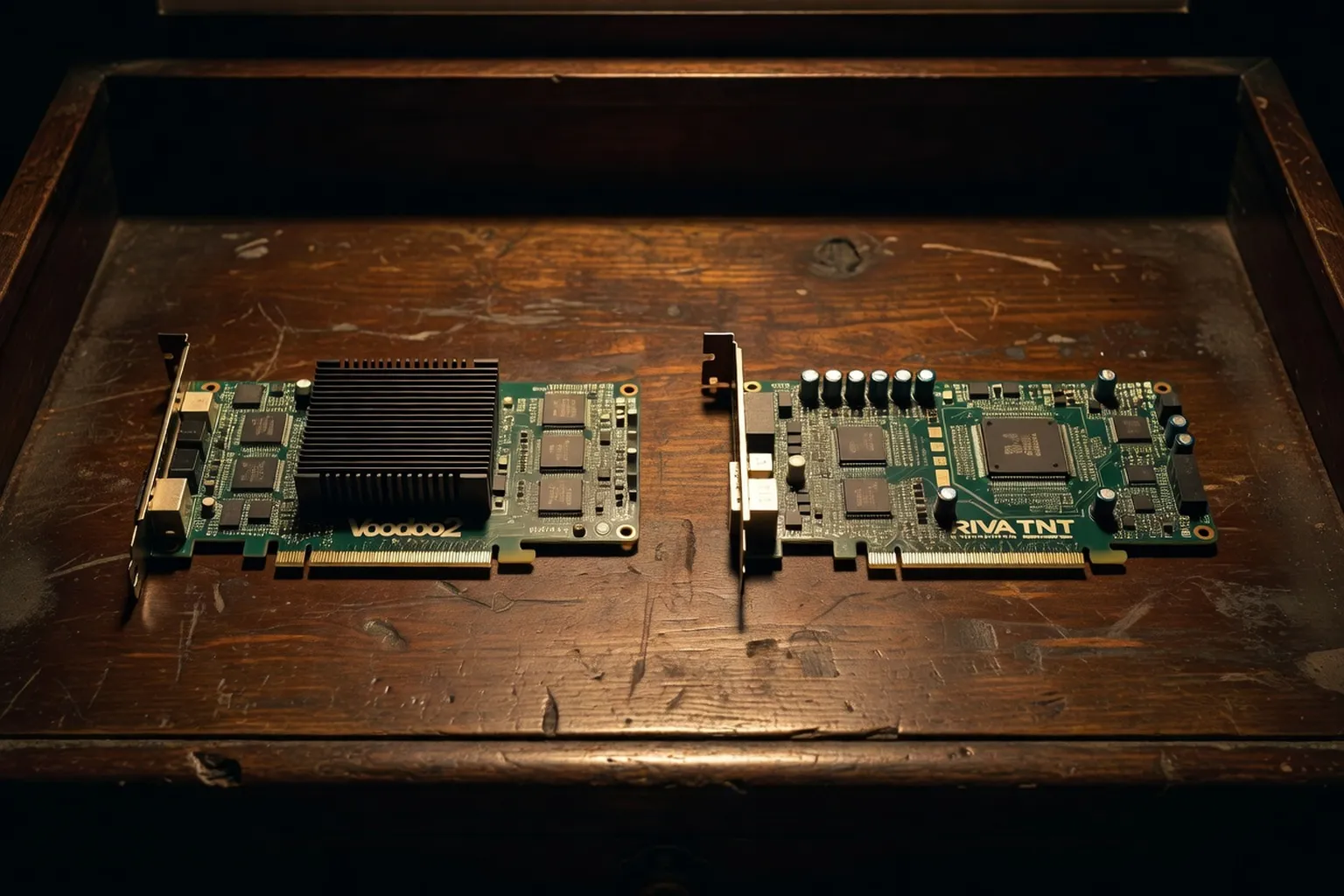
In 1998, two graphics cards fought for dominance of the fledgling 3D gaming market. The 3DFX Voodoo2 and NVIDIA's RIVA TNT represented fundamentally different philosophies — and their competition defined how GPUs would evolve for the next two decades.
For a contemporary perspective on the evolving GPU industry, weekly summaries at i-actu (broader tech news from France) cover the AMD–NVIDIA–Intel triopoly emerging today.
For a 2026 perspective on the same modern GPU rivalry, our GPU specs glossary decodes today’s vocabulary that did not yet exist in 1998.
The world before 3D acceleration
For most of the early 1990s, PC gaming meant software rendering. The CPU did everything: geometry, texturing, lighting, the lot. When id Software released Doom in 1993, it was a marvel not because of hardware acceleration but because John Carmack had wrung every cycle out of a 486. The game wasn’t even true 3D — it was a clever 2.5D engine that drew column-by-column slices of walls.
Quake changed everything in 1996. For the first time on PC, true polygonal 3D ran in real time on consumer hardware, and the demand for floating-point math outpaced what even a Pentium could deliver. The message was clear: the future belonged to dedicated graphics silicon.
3DFX shipped the Voodoo Graphics chipset in late 1996, and it landed like a thunderclap. Quake at 640x480 ran at 30+ fps with bilinear filtering, colored lighting, and transparency no software renderer could match. The Voodoo wasn’t a complete graphics card — it had no 2D output and required a pass-through cable from your existing VGA card — but nobody cared. It made 3D games look like the box screenshots.
By 1997, 3DFX’s Glide API had become the de facto standard for performance gaming, and OpenGL ICDs were maturing. A separate 3D-only accelerator made sense at the time precisely because the technology was so new that asking one chip to do everything was asking too much.
The 3DFX Voodoo2: a single-purpose accelerator
The Voodoo2 was a refinement of a winning formula rather than a reinvention. 3DFX kept the pass-through architecture: you needed a separate 2D card (a Matrox Millennium or a Number Nine Imagine were popular choices) and a short VGA loopback cable connected the two. Purists hated the cable; performance buyers didn’t care.
Under the hood, the Voodoo2 ran at 90 to 100 MHz depending on the board partner, and shipped with 12 MB of EDO RAM split into 4 MB for the framebuffer and 8 MB for textures. The big architectural change was a second texturing unit. The original Voodoo could apply one texture per pixel per pass; the Voodoo2 could apply two, which meant multi-texturing effects like lightmaps in Quake II ran in a single pass instead of two. That alone explained much of its performance lead.
3DFX also introduced the original SLI — Scan-Line Interleave — which let two Voodoo2 cards split rendering work, one drawing odd scanlines and the other drawing even ones. A pair of Voodoo2s at 1024x768 was the absolute performance king of 1998, priced at roughly $600 for two cards plus whatever 2D card you already owned. Few people bought SLI, but the benchmarks circulated through every PC magazine of the period.
Glide remained 3DFX’s secret weapon. The API was lean, gaming-focused, and gave developers direct access to Voodoo hardware without the abstraction overhead of Direct3D. Games written natively for Glide ran measurably faster on Voodoo silicon, and that performance gap was the moat 3DFX believed would protect them.
The NVIDIA RIVA TNT: 2D and 3D in one card
NVIDIA had been a quiet player up to this point. The NV1 was a commercial failure, and the original RIVA 128 from 1997 was competitive but not dominant. The RIVA TNT, launched in mid-1998, was the company’s first card built specifically to challenge 3DFX head-on.
Those who lived through the Voodoo2-versus-RIVA TNT era often appreciate today’s best gaming monitor guide for 2026 — the displays of 1998 (CRT shadow masks at 60Hz) feel quaint by comparison.
For the modern equivalent of building one of these dream rigs around a flagship GPU, our PC build guide for 2026 walks through the process step by step.
The TNT ran at 90 MHz and shipped with 16 MB of SDRAM — more memory than the Voodoo2 and fast enough to do something the Voodoo2 simply could not: render in 32-bit color. The Voodoo2 was locked to 16-bit color depth, which produced visible banding in dark scenes and sky gradients. The TNT could render at 24-bit internal precision with a 32-bit framebuffer, and the difference was immediately obvious in games like Unreal and Need for Speed III.
The TNT was also a complete graphics card. No pass-through cable, no separate 2D board, no extra slot consumed. You bought one card, installed it, and it handled Windows desktop, video playback, and 3D. For mainstream buyers who didn’t own a high-end 2D card, this design was an easier sell.
The name “TwiN Texel” referred to the TNT’s two pixel pipelines, each with its own texturing unit. Like the Voodoo2, the TNT could handle multi-texturing in a single pass, but it processed two complete pixels in parallel rather than one pixel with two textures. This was a different architectural bet, and it favored Direct3D 6.0 workloads where games were increasingly using complex per-pixel calculations rather than stacking texture passes.
NVIDIA also leaned hard into Direct3D and OpenGL compatibility. There was no proprietary TNT API, and that decision proved decisive within two years.
Benchmark numbers from the period
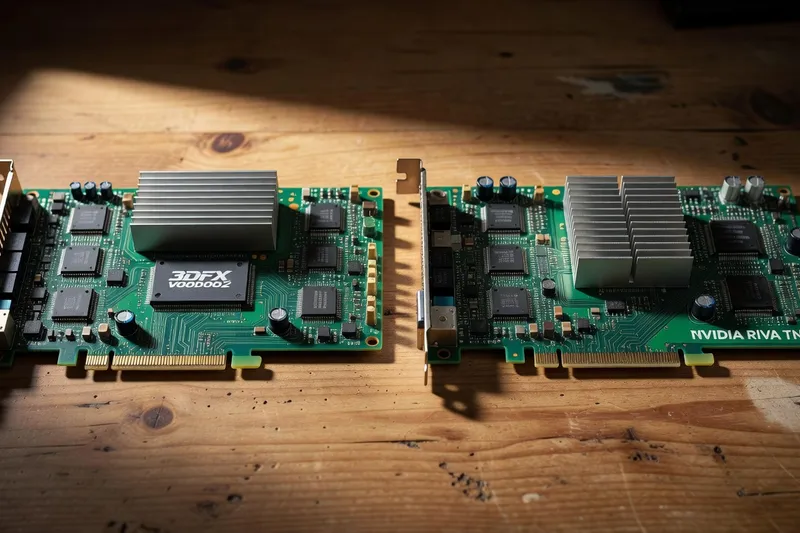
Period-correct numbers tell the story better than any architectural diagram. We pulled these from Computer Heaven’s archived 1998 test suite, run on a Pentium II 400 with 128 MB of SDRAM under Windows 98. All resolutions are 1024x768, with 16-bit color for fair Voodoo2 comparison.
| Benchmark | Voodoo2 (Glide) | RIVA TNT (D3D) |
|---|---|---|
| Quake II demo1 | 38 fps | 31 fps |
| Quake II demo1 (Voodoo2 SLI) | 65 fps | n/a |
| Unreal flyby | 27 fps | 33 fps |
| Forsaken | 41 fps | 36 fps |
| Half-Life timedemo | 44 fps | 39 fps |
| Incoming benchmark | 35 fps | 32 fps |
In Glide-native titles like Quake II, the Voodoo2 had a clear lead. The Voodoo2 SLI numbers were staggering for the time — 65 fps in Quake II at 1024x768 was a frame rate most people had only seen on professional workstation cards costing five figures.
Unreal was the most interesting case. The game launched with a Glide renderer that ran fastest on Voodoo2, but its Direct3D path was tuned for the TNT and looked better there because of 32-bit color. Forsaken and Half-Life favored Voodoo2 in raw frames, but reviewers consistently noted that the TNT delivered cleaner image quality and smoother gradients.
The numbers also hid an awkward truth: at 800x600 and below, both cards were CPU-limited on a Pentium II 400. The real differentiation only appeared at 1024x768 and 1280x1024, resolutions most 1998 monitors couldn’t even sync to.
What the war proved
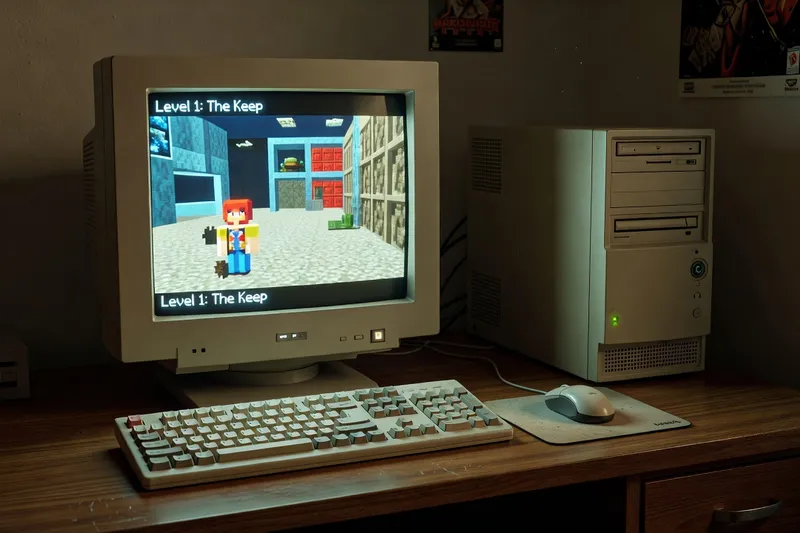
History decided this fight quickly, and not in 3DFX’s favor. Within eighteen months of the Voodoo2 launch, NVIDIA had shipped the TNT2, then the GeForce 256, and Glide’s market share was collapsing. Microsoft’s DirectX 7 closed most of the performance gap that had once justified a proprietary API, and developers started writing Direct3D-first because it ran everywhere, not just on 3DFX hardware.
The modern equivalent of the Voodoo2-versus-RIVA TNT debate is documented in our in-depth RTX 5090 review.
3DFX made the strategic error of buying STB Systems in 1999 and trying to manufacture cards in-house rather than licensing chipsets to third parties. The Voodoo3, Voodoo4, and Voodoo5 ranges shipped late, missed performance targets, and lacked the 32-bit color and large texture support that had become table stakes. NVIDIA finished the job in late 2000 by acquiring 3DFX’s assets outright, absorbing engineers, patents, and the SLI brand name itself.
The bigger lesson of 1998 was architectural. NVIDIA bet that one card doing everything — 2D desktop, video, and 3D — would beat a specialist 3D accelerator over the long run, and they were right. By 2000, no one wanted two graphics cards and a pass-through cable in their PC.
The competitive template was set, too. From that moment on, the GPU market would have two dominant players locked in a relentless cycle: launch a flagship, claim the performance crown, drop prices on the previous generation, repeat every twelve to eighteen months. ATI replaced 3DFX as NVIDIA’s primary rival, then AMD absorbed ATI, and the duopoly has continued essentially unbroken into 2026.
From 1998 to 2026: the descendants
The architectural DNA of the RIVA TNT runs in a direct line to today’s GPUs. The two-pixel-pipeline design grew into the four-pipeline GeForce 256, then into the programmable shaders of the GeForce 3, then into the massively parallel unified shader arrays that power every modern GPU. The principle is the same — process many pixels in parallel with general-purpose math units — just scaled by six orders of magnitude. A 2026 flagship has tens of thousands of shader cores doing what two TNT pixel pipelines did in 1998.
The Voodoo2 lineage is more diffuse but still visible. Multi-texturing in a single pass is so fundamental now that no modern game would function without it. The texture mapping units in a 2026 GPU trace their conceptual origin to the Voodoo2’s twin TMUs, even after dozens of generations of refinement. SLI as a brand passed to NVIDIA in the 3DFX acquisition and lived on through the late 2000s and 2010s before being retired in favor of NVLink and software-driven multi-GPU rendering.
Glide itself never came back, but its philosophical descendant is everywhere. Vulkan, Direct3D 12, and Metal all expose hardware more directly than the abstraction-heavy APIs of the early 2000s, giving engine developers the kind of low-overhead control that Glide pioneered. The lesson 3DFX taught — that closer access to silicon means more performance — was absorbed by the entire industry.
What’s most striking is how recognizable the 1998 debate sounds today. Performance versus image quality, proprietary versus open APIs, single-purpose accelerators versus all-in-one designs. The terms have changed, but the arguments haven’t. To understand the modern GPU landscape in 2026, the Voodoo2 versus RIVA TNT war remains the founding text of the consumer 3D graphics industry.